


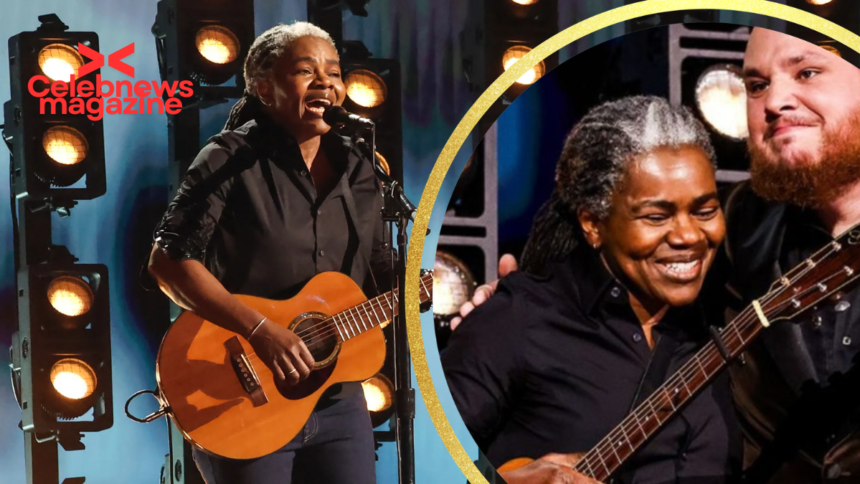
Discover the truth about Tracy Chapman husband full life story, the iconic Fast Car Grammy performance with Luke Combs, her net worth, awards, top songs, and where she is in 2026. A complete, in-depth profile.
Quick Facts
| Detail | Information |
|---|---|
| Full Name | Tracy Chapman |
| Date of Birth | March 30, 1964 |
| Age (2026) | 61 years old |
| Birthplace | Cleveland, Ohio, USA |
| Nationality | American |
| Height | 5 ft 5 in (165 cm) |
| Profession | Singer-Songwriter, Activist |
| Genres | Folk, Rock, Blues, Pop |
| Record Label | Elektra Records (signed 1987) |
| Husband / Spouse | Never married; personal life kept private |
| Children | None |
| Net Worth (2026) | Estimated $6 million – $8 million |
| Grammy Awards | 4 Grammys (Best New Artist, Best Female Pop Vocal, Best Contemporary Folk Album ×2, Best Rock Song) |
| Most Famous Song | Fast Car (1988) |
| Last Album | Our Bright Future (2008) |
| Current Residence | San Francisco, California |
Tracy Chapman Biography: From Cleveland to Global Stardom
Tracy Chapman’s story is one of those rare, genuinely American journeys — from a welfare household in Cleveland, Ohio, to the biggest stages on earth. Born on March 30, 1964, she was raised almost entirely by her mother after her parents divorced when she was just four years old. Money was tight, but her mother understood the value of music. She bought young Tracy a ukulele at age three, and by eight Tracy was already strumming a guitar and writing her own songs. That early head start would define everything that followed.
Growing up during the desegregation of public schools in Cleveland, Tracy experienced racial bullying and social exclusion that would later fuel some of her most powerful lyrics. Rather than letting those hardships silence her, she channelled them into songwriting with a directness and empathy that set her apart from the very beginning. She was accepted into the A Better Chance program, which helped underserved students gain access to top private schools, and eventually graduated from Wooster School in Connecticut before earning a place at Tufts University in Massachusetts, where she majored in anthropology and African studies.
At Tufts, Tracy wasn’t just studying — she was performing. She busked at Harvard Square, played coffeehouses, and recorded demos at the campus radio station, WMFO. It was there that fellow student Brian Koppelman overheard her and brought her to the attention of his father, music industry veteran Charles Koppelman, who ran SBK Publishing. Koppelman senior signed her in 1986, and after she graduated the following year, helped her secure a contract with Elektra Records. The rest, as they say, is music history.
Tracy Chapman Age and Early Musical Roots
As of 2026, Tracy Chapman is 61 years old, and she carries those years with a quiet grace that feels entirely in keeping with her music. Her age speaks not just to longevity but to the remarkable consistency with which she has held her artistic values intact across nearly four decades in an industry that rarely rewards integrity quite so generously. She has spoken in recent interviews about watching the TV show Hee Haw as a child, which she credits as an unlikely early spark for her love of guitar. That self-deprecating honesty — finding inspiration in the unexpected — is a thread that runs through everything she has ever done.
Tracy Chapman Fast Car: The Song That Changed Everything
Released in 1988 as the lead single from her self-titled debut album, “Fast Car” is one of those songs that feels like it has always existed. Its opening guitar riff is instantly recognisable, and its story — a young woman dreaming of escape from poverty and a difficult home life — struck a chord that resonated far beyond the folk circuit. The song peaked at number six on the Billboard Hot 100 in August 1988 and earned Tracy the Grammy for Best Female Pop Vocal Performance.
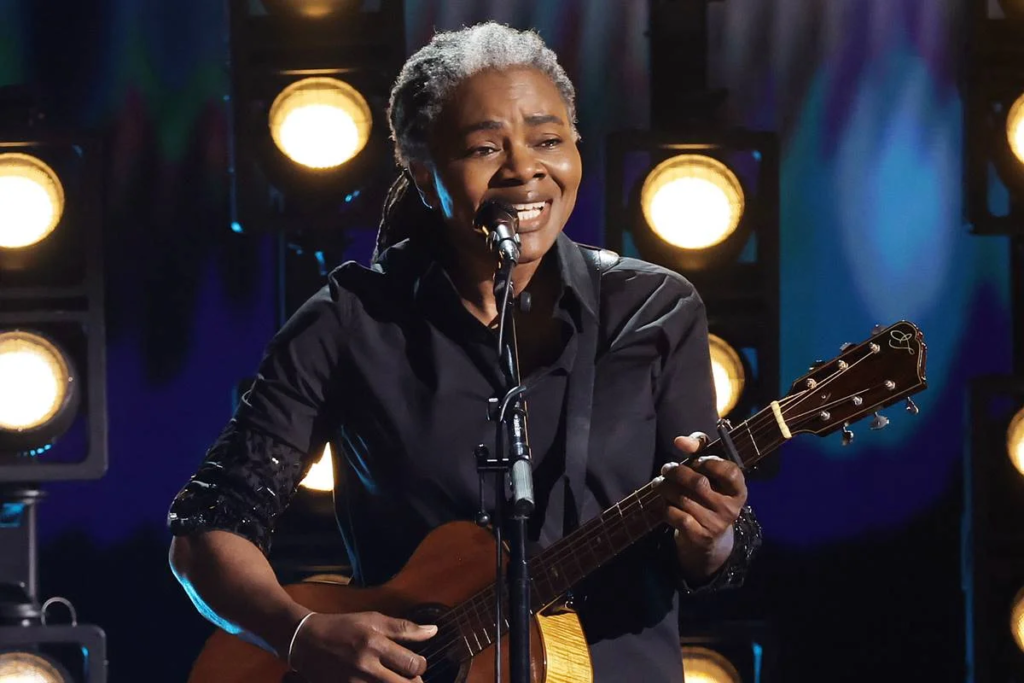
What truly rocket-launched the song into the cultural stratosphere was a performance that happened almost by accident. At the televised Nelson Mandela 70th Birthday Tribute concert at Wembley Stadium in London in June 1988, Tracy was originally scheduled for a modest afternoon slot. When Stevie Wonder was unable to perform due to a last-minute technical issue with his equipment, Tracy stepped in as a replacement and played to a global audience of hundreds of millions. By the time she finished, “Fast Car” was on its way to becoming an anthem.
Rolling Stone later ranked it at number 167 on their list of the 500 Greatest Songs of All Time. It remains the defining track of her career — and, remarkably, it found a second life more than three decades later.
Tracy Chapman and Luke Combs Grammy Performance: A Historic Moment
In 2023, country superstar Luke Combs included a cover of “Fast Car” on his album Gettin’ Old. His version shot to number one on the Country Airplay chart in July 2023, and in doing so created a piece of music history: Tracy Chapman became the first Black woman ever to score a country number one with a solo composition. That alone would have been remarkable enough.
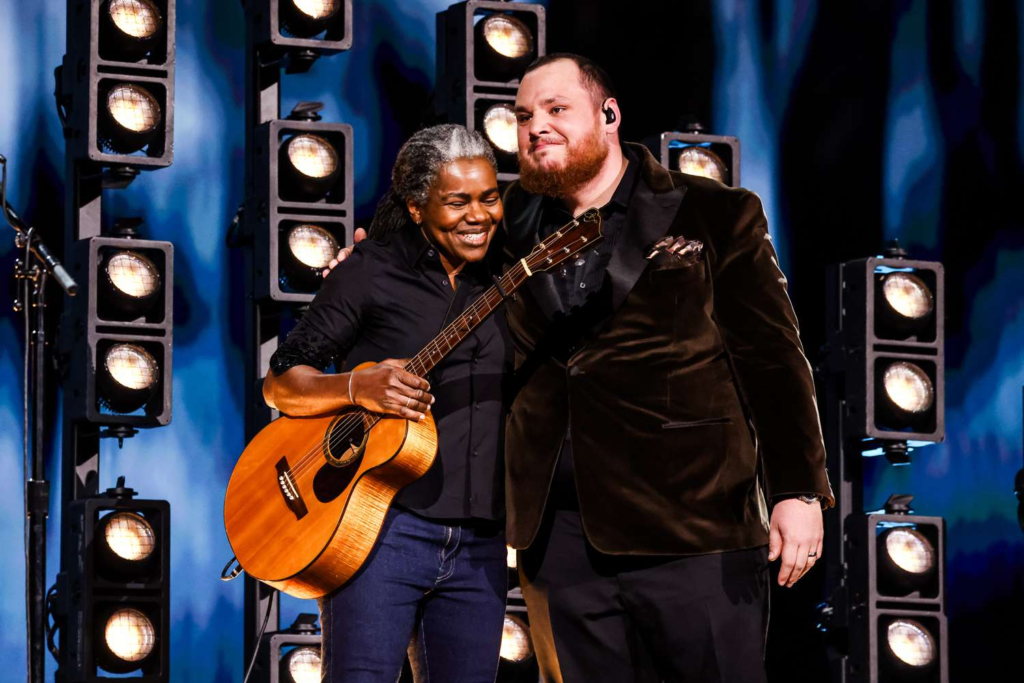
But the real emotional peak came in November 2023 at the 57th Annual Country Music Association Awards, where “Fast Car” won Song of the Year. Tracy — who declined to attend — became the first Black woman to win a CMA Award, and the first Black songwriter to take home Song of the Year. Then, on February 4, 2024, at the 66th Grammy Awards, she made a surprise appearance on stage to perform “Fast Car” as a duet with Combs. The performance stopped the room. Viewers watching from home described it as one of the most emotionally affecting moments in recent Grammy history.
“In a word, it was great. It was awesome. It was a very emotional moment for so many reasons. Luke is a lovely person. Before deciding to do it, we had a good talk, and we were both on the same page about how we would approach it.” — Tracy Chapman, New York Times, April 2025
She later admitted she was weepy for weeks afterward. The performance introduced her music to an entirely new generation of listeners and prompted a rush of album sales and streaming activity that few artists with a 35-year-old debut could ever have anticipated.
Tracy Chapman Husband: The Truth About Her Personal Life
One of the most searched questions about Tracy Chapman is whether she has a husband or has ever been married. The short, honest answer is: no, Tracy Chapman has never married, and she has no confirmed husband or partner on public record. She has kept her romantic life almost entirely out of the public eye throughout her entire career, and she has been remarkably consistent about protecting that privacy.
The only notable public comment about a romantic connection came from author and feminist Alice Walker, who claimed in an interview that the two had been in a relationship during the mid-1990s. Walker spoke warmly about the experience, describing it as wonderful and loving, but Tracy herself has never confirmed or denied the claim. She has no children. For someone who has spent decades writing songs of breathtaking emotional intimacy, her personal reserve is a deliberate and well-maintained choice — one that commands respect rather than fuelling speculation. As of 2026, she lives quietly in San Francisco, California.
Tracy Chapman Net Worth: How Much Has She Earned?
Tracy Chapman net worth is estimated to be between $6 million and $8 million as of 2026. That wealth has been built steadily over four decades through album sales, touring, royalties, and the ongoing commercial life of a catalog that remains remarkably active. Her debut album alone sold over 20 million copies worldwide and generated significant long-term royalty income. Her 1995 album New Beginning sold five million copies in the US and produced the Grammy-winning single “Give Me One Reason,” adding another major revenue chapter to her career.
A notable real estate transaction also contributed to her financial picture: in 1997 she paid $970,000 for a property in Half Moon Bay, California, which she apparently sold in November 2017 for a reported $5 million — a fivefold return over two decades. The renewed commercial surge triggered by the Luke Combs cover of “Fast Car” in 2023 and 2024, along with the viral Grammy performance and a vinyl reissue of her debut album in April 2025, will have added meaningfully to her royalty income in recent years. While she is not among the wealthiest musicians in the world, her financial position is secure and well-earned.
Tracy Chapman Songs: Her Most Iconic Tracks
Tracy Chapman’s discography spans eight studio albums and runs from 1988 to 2008, but a handful of songs define her legacy more than any album title. “Fast Car” remains her signature work and the song most new listeners discover first. “Talkin’ ’bout a Revolution” from that same debut album is a folk anthem for social change that still resonates in protest movements today. “Baby Can I Hold You,” also from the debut, is a quiet masterpiece of romantic regret that has been covered by artists ranging from Boyzone to Bob Marley tribute acts.
“Give Me One Reason,” released on her 1995 album New Beginning, showed a bluesier, looser side of Chapman and became her biggest chart hit, peaking at number three on the Billboard Hot 100 and winning the Grammy for Best Rock Song in 1997. “The Promise,” “New Beginning,” and “Mountains o’ Things” are among the other album tracks that have built deep loyalty among her fanbase over the years. What unites all of her best songs is an economy of language — she never uses ten words when five will do — combined with a gift for finding the universal inside the deeply personal.
Tracy Chapman Awards: A Record-Breaking Career
Tracy Chapman has won four Grammy Awards over the course of her career. Her 1989 haul from the debut album included Best New Artist, Best Female Pop Vocal Performance for “Fast Car,” and Best Contemporary Folk Album. She later won Best Contemporary Folk Album again for New Beginning in 1996, and Best Rock Song for “Give Me One Reason” in 1997. Her debut album received six Grammy nominations in total, including Album of the Year.
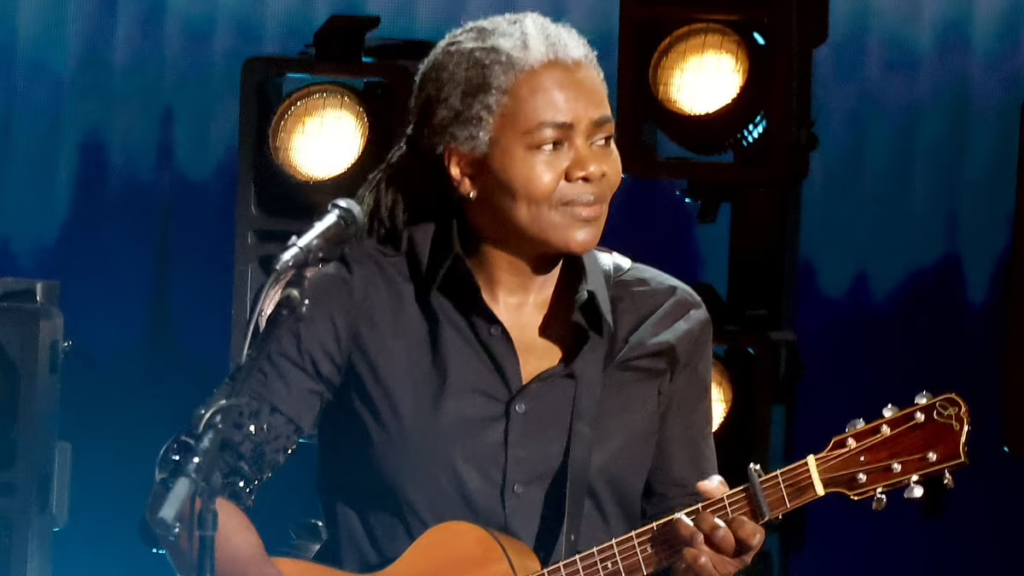
The CMA Song of the Year win in 2023 was a landmark moment that carried significance far beyond a trophy. Becoming the first Black woman and first Black songwriter to win that particular award, in a genre with a historically complicated relationship with race, was a cultural milestone that drew widespread attention. In April 2025, the Library of Congress formally preserved her self-titled debut album in the National Recording Registry, a recognition reserved for recordings deemed culturally, historically, or aesthetically significant. It is, in many ways, the highest honour American music can bestow on a recorded work.
Tracy Chapman 2026 Performance: Is She Touring or Recording?
As of early 2026, Tracy Chapman has no confirmed tour dates and no announced new album, but she is far from inactive. In a candid interview with Billboard in April 2025, tied to the vinyl reissue of her debut album, she made her position clear: she would only tour in support of new material, and right now the writing process is ongoing. “Whether or not I’m in the studio or going on tour, I’m always writing, always playing, always practicing,” she said. That’s not the statement of someone who has retired — it’s the statement of someone on her own timeline.
The vinyl reissue of her 1988 debut album, released on April 4, 2025, hit the top ten on Billboard’s Album Sales Chart and also charted on the Top Rock Albums, Americana/Folk Albums, and Vinyl Albums charts. It was a powerful reminder that her music continues to find new ears without any of the usual promotional machinery. She has expressed concern about the state of American democracy in recent interviews, suggesting that her social conscience remains as sharp as it was when she first picked up a guitar.
More Read

Tracy Chapman Where Is She Now: A Life on Her Own Terms
Tracy Chapman lives in San Francisco and has been there for many years. She doesn’t stream music — she buys CDs and vinyl, because she believes artists deserve to be paid properly. She doesn’t maintain a major social media presence. She doesn’t do press unless she has something she genuinely wants to say. She is, in an era of relentless personal branding and oversharing, an almost radical anomaly: an artist who lets the work speak and trusts the audience to find it.
The past two years have brought a remarkable second chapter to her story — one she neither engineered nor particularly sought out. The Luke Combs cover, the CMA history, the Grammy performance, the vinyl reissue, the Library of Congress honour — all of it arrived without Tracy Chapman doing very much at all except continuing to be Tracy Chapman. That, perhaps, is the most enduring thing about her. In a music industry that rewards noise, she has always chosen depth. And depth, it turns out, never goes out of style.